
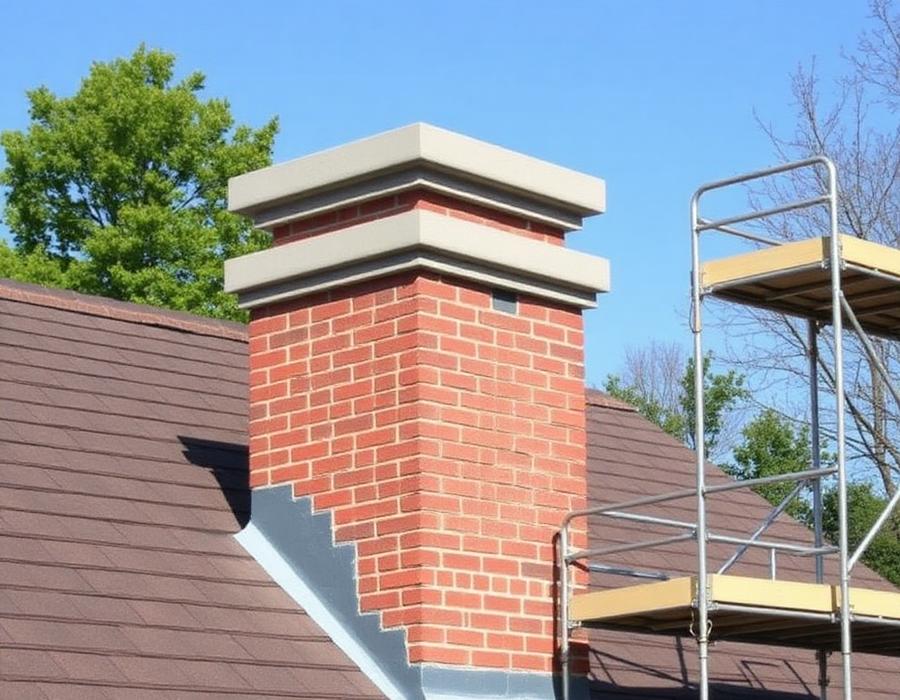
The crown is the concrete slab across the top of your chimney, and it is the structure's roof. Its job is to shed water away from the masonry below and away from the flue. When it cracks, water pours into the core of the chimney and works its way down through every joint — which is why crown failure is behind a huge share of the spalled brick, rusted dampers, and ceiling stains we get called about.
Peters Chimney Masters repairs, resurfaces, and rebuilds chimney crowns to a standard that actually lasts: proper slope, a real overhang with a drip edge, reinforcement, and an expansion joint at the flue.
Why most crowns fail
The majority of failed crowns we encounter were never crowns at all — they are mortar washes. A mason finishing a chimney troweled leftover mortar across the top, sloped it roughly, and called it done. Mortar is not formulated for horizontal weather exposure. It has no reinforcement, minimal tensile strength, and it cracks within a few years of thermal cycling.
The second failure mode is a crown poured flush to the brick edge with no overhang. Without an overhang and drip edge, runoff sheets straight down the face of the chimney, saturating the brick and eroding the joints beneath.
The third is a crown poured tight against the flue tile. The clay flue heats and expands at a different rate than the concrete around it, and with no bond break the crown cracks radially from the flue outward — usually within the first several seasons.
Repair versus full replacement
Not every cracked crown needs replacing. When the structure is sound and cracking is limited to hairline surface fractures, we clean and prepare the surface and apply a flexible, elastomeric crown coating. It bridges existing cracks, remains flexible through thermal movement, and typically carries a long service life. It is a legitimate repair, not a cosmetic patch, and it is dramatically cheaper than a rebuild.
When cracks are wide, the crown is spalling, sections are missing, or the slab has no overhang at all, coating over it just buys a season. In that case we remove the failed crown and pour a new one: reinforced concrete, minimum recommended thickness, sloped away from the flue, extending past the brick face with a formed drip edge, and separated from the flue tile with a compressible bond break so future expansion has somewhere to go.
We show you the crown photos before recommending either path. Homeowners are frequently surprised at how obvious the diagnosis is once they can actually see the top of their chimney.
What crown failure costs if you wait
Water entering through a failed crown does not stay at the top. It saturates the masonry core, dissolving lime from mortar joints and depositing it on the exterior as white efflorescence. It rusts the damper and any steel in the smoke chamber. It soaks into flue tile joints, and when it freezes, it lifts and cracks the tiles.
Beyond the chimney, that water travels along framing, stains ceilings, rots roof sheathing at the chimney penetration, and in the worst cases feeds mold inside a wall cavity. A crown repair is a modest project; the water damage it prevents is not.
Because crown work happens at the top of the structure, we always evaluate the cap and flashing in the same visit. Fixing one water path while leaving another open is not a repair we are willing to sell.
Local crown work with a written guarantee
We repair and rebuild crowns across your local area and the surrounding communities we serve. The regional climate is unusually hard on crowns: intense sun and heat cycling in summer, then concentrated rainfall in winter that tests every crack at once.
Most crown resurfacing jobs are completed in a single day. Full crown replacement typically takes one to two days, including form work and initial cure. We schedule around weather so nothing is poured into rain.
All crown work is covered by our written workmanship guarantee, and estimates are free.
Warning signs to watch for
Visible cracks across the top
Any crack wide enough to see from the ground is admitting water into the chimney core.
Concrete chunks on the roof
Crown material breaking loose means the slab is actively failing.
No overhang past the brick
A flush crown sends every drop of runoff down the chimney face.
Efflorescence below the crown
White chalky staining directly beneath the crown is the classic signature of crown leakage.
Get your free chimney crown repair estimate today
Free written estimates, same-day service windows, and licensed technicians seven days a week. Call now and speak with someone who actually works on chimneys.
Call (866) 752-4313