
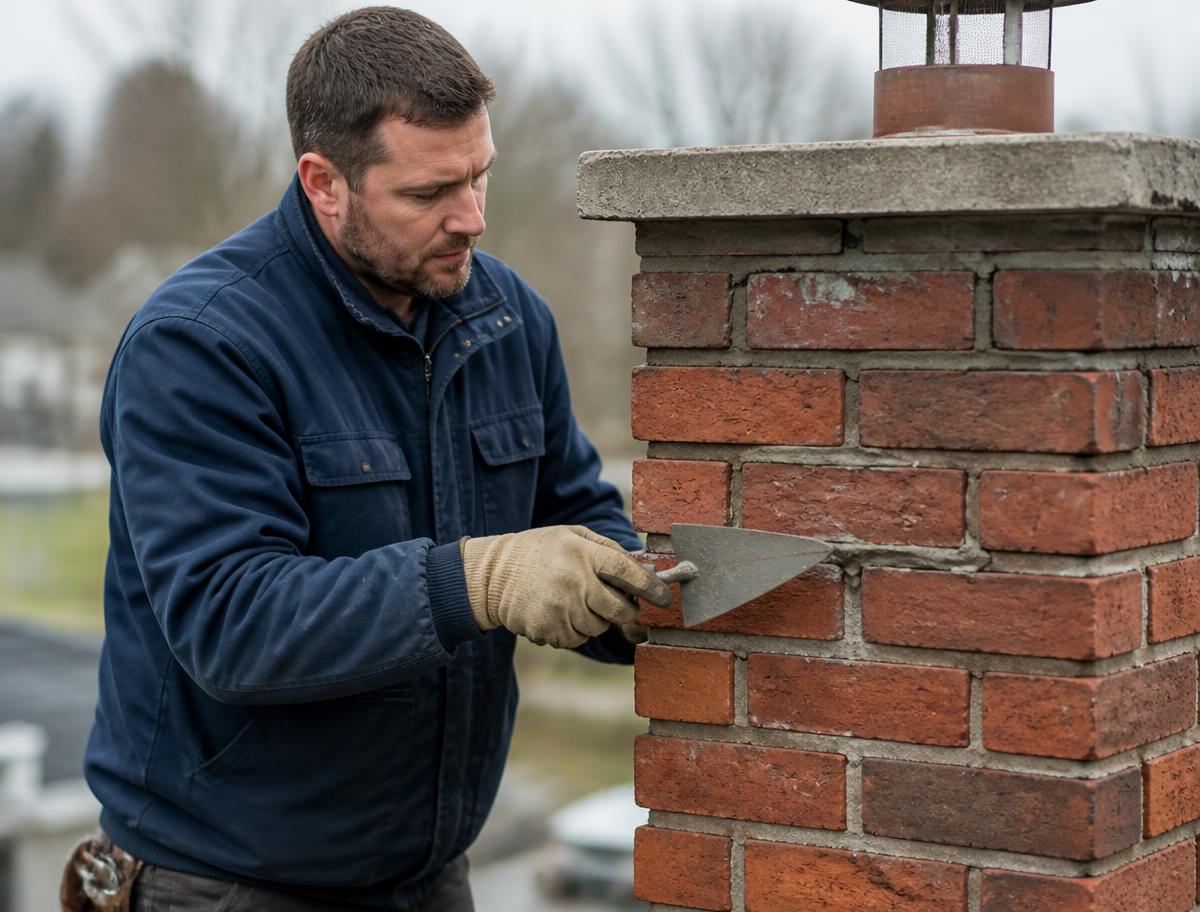
Chimneys fail slowly and then all at once. A hairline crack in a mortar joint admits a small amount of water; that water freezes, expands, and widens the crack; the next season it admits more. Left alone for a few years, a repair that would have cost a few hundred dollars becomes a rebuild. Peters Chimney Masters diagnoses the actual cause of the damage and repairs it properly, so you are not paying to fix the same thing twice.
We handle the full spectrum — mortar joints, brick replacement, flue tile repair, damper and firebox work, crown restoration, and flashing — and we tell you plainly which items are safety-critical and which can reasonably wait.
The repairs homeowners need most
Deteriorated mortar joints are the most common finding. Mortar is intentionally softer than brick so it can absorb movement, which means it erodes first. Once joints recede past about a quarter inch, water penetrates the chimney's core and the structure begins losing integrity from the inside. Tuckpointing — grinding out the failed mortar and repacking the joints with a properly matched mix — restores it.
Spalled brick is the next stage. When water saturates a brick and then freezes or bakes, the face pops off, exposing the soft interior to accelerated erosion. Spalled units must be cut out and replaced individually; sealing over them traps moisture and speeds the failure.
Inside the flue, cracked or displaced clay tiles compromise the barrier between combustion gases and your home's framing. Depending on severity we repair joints from inside the flue with cast-in-place products or recommend a stainless steel liner. Dampers that will not seal, rusted-through smoke chamber parging, and cracked firebox panels round out the list of repairs we perform routinely.
Why proper diagnosis matters more than the patch
Most chimney damage is water damage wearing a different name. A crown that has cracked lets water into the top of the structure; the water travels down through the masonry core and shows up as spalled brick five feet lower, or as a damp spot on a bedroom ceiling. Repointing the visible damage without fixing the crown means the same joints fail again in two seasons.
So we trace it back. Where is water entering? Is the cap present and correctly sized? Is the crown sloped and sealed, or is it a flat mortar wash that has cracked through? Is the flashing properly stepped and counterflashed into a mortar joint, or is it caulked to the brick face — a shortcut that fails within a few years?
Only after that chain is understood do we quote repairs, and we quote the whole chain rather than the symptom. That is usually cheaper over five years, and it is always cheaper over ten.
Materials and workmanship standards
Mortar mix matters enormously on older chimneys. Modern high-Portland mortar is harder than the soft historic brick common in homes built before 1930. When a hard mortar meets a soft brick, the brick becomes the sacrificial element and spalls at the joint edges. We match mix strength and color to the original so repairs are both durable and visually invisible.
For brick replacement, we source units matched on size, texture, and color rather than settling for close-enough. On rebuilds and crown work we use reinforced, air-entrained concrete with a proper overhang and drip edge, plus a bond break at the flue so thermal expansion does not crack the new crown.
Flashing is repaired the correct way: step flashing woven into the roof courses, counterflashing let into a cut mortar joint and sealed, never a bead of caulk against a brick face.
Repair timelines and free estimates
Small repairs — cap installation, damper replacement, minor crown patching — are typically completed in a single two to four hour visit. Tuckpointing a chimney above the roofline usually takes a full day. Crown rebuilds run one to two days including cure time, and partial rebuilds take two to four days.
We serve homeowners across your local area and the surrounding communities we serve, and all repair estimates are free, written, itemized, and valid for 30 days.
If the inspection reveals an active safety hazard — a compromised liner, a separated flue, a chimney leaning away from the house — we will tell you to stop using the fireplace until it is corrected, and we will prioritize your job accordingly.
Warning signs to watch for
Crumbling mortar or falling debris
Sand-like grit or brick fragments in the firebox or on the roof means active deterioration.
White chalky staining
Efflorescence on exterior brick proves water is moving through the masonry.
Rusted damper or firebox
Rust indicates persistent moisture entering from above and is rarely an isolated problem.
Gaps at the roofline
Failing or caulked-only flashing is one of the most common causes of interior water damage.
Get your free chimney repair estimate today
Free written estimates, same-day service windows, and licensed technicians seven days a week. Call now and speak with someone who actually works on chimneys.
Call (866) 752-4313